Significant progress on ultraflexible solar cells
A collaborative group including Monash has produced an ultra-thin and ultra-flexible organic solar cell for advanced wearable devices.


Showing 61 - 80 of 112 results
A collaborative group including Monash has produced an ultra-thin and ultra-flexible organic solar cell for advanced wearable devices.
Multi-faceted approach to dating Australian Indigenous rock art from Kimberley region
International research led by Curtin University and supported by ANSTO, has identified and studied the first sauropod dinosaur gut contents found anywhere in the world. The stomach content was preserved with a reasonably complete skeleton of the Australian Cretaceous species Diamantinasaurus matildae found in Winton Queensland.
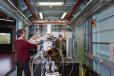
Beamtime Guide on the X-ray Fluorescence Microscopy beamline at the Australian Synchrotron.
International researchers have used nuclear techniques at ANSTO - a centre for food materials science - to develop a methodology that could assist in the design of oleogel systems for food applications.
Researchers from UNSW have found an extraordinary material that does expand or contract over an extremely wide temperature range and may be one of the most stable materials known.

Understanding of the role that programmed cell death has in development.

Research has demonstrated that internally generated neutrons could be used to effectively target micro-infiltrates and cancer cells outside of the defined treatment regions.


A paper led by researchers at the University of New South Wales (UNSW) published in the PNAS last year has confirmed the theory that echidnas and platypuses descended from an aquatic ancestor with fossil evidence.

Online and interactive while in your home. Kids can zoom into these school holidays workshops and create movies, animations, arcade games, roller coasters and more. Limited spaces: book now.


Role at ANSTO