

Showing 21 - 40 of 526 results
ANSTO scientists among recipients of 2024 Australian Neutron Users Group Awards
ANSTO welcomes revitalised National Science and Research Priorities and National Science Statement
(ANSTO) has welcomed the launch of the new National Science Statement and revitalised National Science and Research Priorities by Minister for Industry and Science, The Hon Ed Husic MP and Australia’s Chief Scientist, Dr Cathy Foley AO PSM.

Privacy Policy
Australian Nuclear Science and Technology Organisation (ANSTO) is committed to protecting your personal information in accordance with the Privacy Act 1988 (Cth) (Privacy Act) and the Australian Privacy Principles.

Connect with ANSTO's Women in STEM
Read about an ANSTO scientist and their work to prepare for a school project or interview.
ANSTO taking part in international coastal pollution studies
Successful Repatriation of Australia's Radioactive Waste
The Australian Government’s nuclear agency, ANSTO, together with NSW Police and multiple state and federal authorities, has completed an operation to repatriate radioactive waste from the UK.

Advanced Diffraction & Scattering Beamlines (ADS-1 and ADS-2) UNDER CONSTRUCTION
The Advanced Diffraction and Scattering beamlines (ADS-1 and ADS-2) are two independently operating, experimentally flexible beamlines that will use high-energy X-ray diffraction and imaging to characterise the structures of new materials and minerals.
Application approved for operation of interim waste store
New laboratory opens
A new source added to ANSTO’s cosmogenic toolkit to study past climate and landscape change
3D cell printing technology earns ANSTO Eureka Prize for Technology
Researchers and industry partners from UNSW Australia, the Australian Centre for Nanomedicine, Children’s Cancer Institute and Inventia Life Sciences Pty Ltd have been awarded the 2021 ANSTO Eureka Prize for Innovative Use of Technology for their method to rapidly-produce 3D cell structures
Graduate Profile - Robert Walwyn
With zero carbon emissions, green hydrogen is a promising fuel for many industries. PhD candidate Robert Walwyn, is researching new, advanced materials for safe and effective hydrogen gas storage.
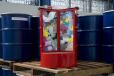
Managing Radioactive Waste
ANSTO has safely managed its radioactive waste for over 60 years. Waste is managed in accordance with national and international standards.
A breakthrough in all-organic proton batteries for safer, sustainable energy storage
Researchers from the University of New South Wales have developed a new type of rechargeable battery that uses protons as charge carriers, offering a safer and more environmentally friendly alternative to conventional lithium-ion batteries.
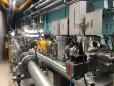
Medium Energy X-ray Absorption Spectroscopy Beamline (MEX-1 and MEX-2)
The Medium Energy- X-ray Absorption Spectroscopy beamlines will provide access to XANES and EXAFS data from a bending magnet source, optimised for cutting-edge applications in biological, agricultural and environmental science in an energy range that is not currently available at the Australia Synchrotron.
Potential good news for a warming world
Collaboration finds that old carbon reservoirs are unlikely to cause a massive greenhouse gas release in a warming world.
Our understanding of the atom powers ANSTO's nuclear and accelerator research techniques
Scientists at ANSTO characterise structures with atomic detail using probes such as x-rays, electrons, neutrons and ions.

Powder Diffraction
The Powder Diffraction beamline at the Australian Synchrotron is optimised for carrying out structural investigation under non ambient conditions and as a function of time.

Nanoprobe beamline (NANO) - under construction
The BRIGHT Nanoprobe beamline provides a unique facility capable of spectroscopic and full-field imaging. NANO will undertake high-resolution elemental mapping and ptychographic coherent diffraction imaging. Elemental mapping and XANES studies (after DCM upgrade) will be possible at sub-100 nm resolution, with structural features able to be studied down to 15 nm using ptychography.
Isoscapes of groundwater in NSW will benefit water managers
A large group of ANSTO environmental scientists and collaborators have produced the first groundwater stable isotopes, ‘isoscapes’, intuitive maps with grid data, across NSW combining new and pre-existing isotope measurements.