Our research
Researchers from the ARC Centre of Excellence in Future Low Energy Electronic Technologies (FLEET) prepared intercalated samples in-situ and transferred them under vacuum to the XPS chamber on the SXR beamline.
The synchrotron allow the researchers to ‘tune’ the X-ray energy. This makes synchrotron XPS quite powerful compared to lab based XPS sources as one will be able to maximise the signal from a desired element and distinguish topmost atomic layers from the bulk hence gaining information from different depths in the sample investigated.
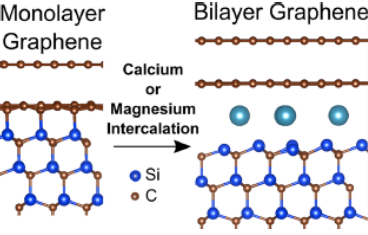
The research group managed to confirm that when calcium atoms were injected into an epitaxial graphene layer on a silicon carbide substrate they would intercalate underneath a partially bonded carbon layer on the surface of the silicon carbide instead of between the graphene layer and the substrate. This partial bonded carbon layer would then lift off and form a new layer of graphene.
The team also investigated magnesium intercalation and found that magnesium behave remarkably similar to calcium with the difference that magnesium intercalated graphene unlike calcium intercalated graphene remained stable in ambient atmosphere for a longer period of time.