

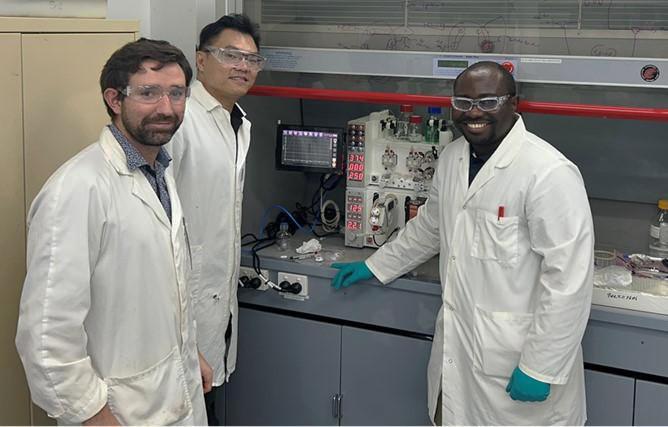
The National Deuteration Facility has developed a capability to use a flow chemistry process to increase efficiency, increase production capacity and reduce decomposition in the synthesis of deuterated molecules.
The research, which was led by chemist Dr Jim Mensah, will not only facilitate the adaptation of established batch processes to continuous flow for multigram-scale synthesis but also encourage the exploration of novel deuteration methodologies.
In a paper published in ACS Catalysis, Dr Mensah and the team reported development of a scalable flow deuteration method that permits the tunable isotopic selectivity of saturated short-chain fatty acids over platinum-group metal (PGM) catalysts.
Traditionally, the high temperature deuteration reactions, greater than 140 °C, are conducted in Parr reactors to manage the high pressures involved, but many functional groups are unstable under such conditions.
“The issue with Parr reactors is reproducibility and scale. With flow chemistry you get much shorter reaction times and higher incorporation of deuterium,” explained Dr Mensah.
“The significant time savings, 18 hours versus 72 hours combined with high yields in the production of multigram-scale deuterated sodium butyrate, is compelling.”
The study included testing the metals platinum against palladium and the use of computational modelling.
“Although the platinum is more expensive, it is more atom efficient, which is important in deuteration,” said Dr Mensah.
“We intend to extend it to other platform molecules like amino acids, sugars and other molecules that are not suitable for the traditional hydrothermal exchange reactions.”
The National Deuteration Facility has recently acquired a Vapourtec flow reactor that integrates real-time monitoring, streamlined processing, and flexible productivity, to advance flow-based deuteration.
“The increasing interest in flow chemistry devices and methods in modern synthesis laboratories suggests that flow-based chemistry is poised to unlock the potential of flow-based deuterium labelling,” said Dr Tamim Darwish, Director, National Deuteration Facility.
This work was supported by NCRIS Uplift funding received in 2023 for the expansion of existing capabilities and development of new capabilities at the NDF-Extension of the use and methods of deuteration for applications beyond neutron scattering to include NMR, IR and MS.
The NDF team adopted flow‑chemistry strategies to overcome the labour‑intensive and scale‑limited nature of batch deuteration. Researchers in other areas of synthetic chemistry have shown that continuous‑flow systems can deliver advantages such as improved scalability, tighter control over reaction conditions, and reduced decomposition.
These demonstrations, spanning work by groups in Europe and elsewhere (e.g., 2025 paper by K. Tatoueix et al in Nature Communications) highlighted how flow can enhance efficiency, selectivity, and throughput across a range of applications.
Building on these broader insights, the NDF team is now applying flow‑based methods specifically to deuterium labelling. By adapting principles proven in other chemical contexts, the team aims to capture the same benefits, greater control, improved reproducibility, and more efficient processing, within deuteration workflows.
The National Deuteration Facility (NDF) synthesises a variety of deuterated molecules using chemical techniques, with the primary method hydrothermal deuteration and heavy water (D₂O) as the deuterium source. This process typically requires metal catalysts such as palladium or platinum at elevated temperatures.
Deuterium-labelled compounds are pivotal in pharmaceutical development, metabolic studies, and materials science due to their distinctive properties. In drug discovery, deuterium substitution can enhance metabolic stability and prolong half-life, leading to the development of "deuterated drugs" with improved pharmacokinetics. Beyond pharmaceuticals, deuteration plays a crucial role in neutron scattering contrast variation, NMR spectroscopy, and isotopic labelling for elucidating complex reaction mechanisms.