

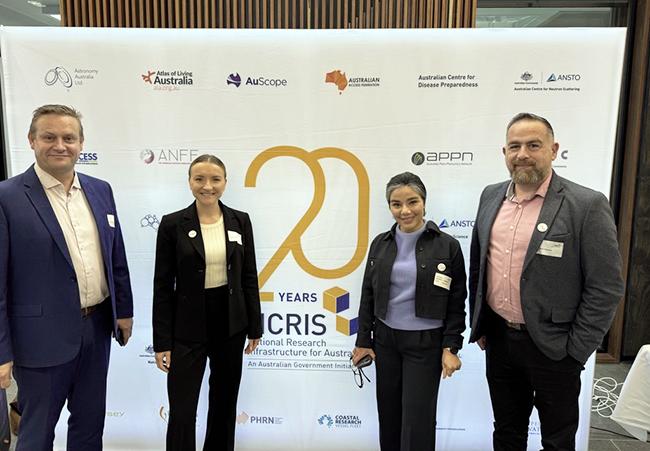
CEO Shaun Jenkinson, Group Executive for Nuclear Science and Technology Andrew Peele and ANSTO NCRIS Facility Directors Jamie Schulz, Tamim Darwish, Ceri Brenner and Mitra Safavi-Naeini, attended the Parliamentary Reception to celebrate the 20th Anniversary of the Australian Government’s National Collaborative Research Infrastructure Strategy (NCRIS) in June.
“The Government funding program, which is the backbone of Australia’s research capabilities, has supported ANSTO facilities over many years, and we are proud to be part of the NCRIS family,” said Mr Jenkinson.
“This investment has made crucial enhancements to infrastructure possible, to broaden the range of our services as well as supporting continued operations.”
The Assistant Minister for International Education, the Hon Julian Hill MP welcomed guests to the gala event, which also included a panel discussion with the Hon Senator Kim Carr.
NCRIS has built one of the world’s most respected research infrastructure systems by delivering nationally coordinated investments and collaboration across institutions. This had led to impact across health, agriculture, energy, defence, environmental science and advanced manufacturing.
The Australian Government has invested $5.5 billion in NCRIS over the past two decades and it has been a cornerstone of Australia’s research and development capability. It supports more than 130,000 Australian and international users each year by providing access to world-class research infrastructure facilitated by technical expertise. It has enabled critical research, innovation and industry-led development through a coordinated network of leading-edge equipment and highly skilled technical staff.
It has enabled 5,000 Australian startups and SMEs to be more innovative and develop new products and industries.
Events were held in Canberra, and across the country, from 29–30 June 2026. The Directors of ANSTO’s infrastructure facilities that have been supported by NCRIS, Dr Jamie Schulz, Dr Tamim Darwish, and Dr Ceri Brenner, attended the Symposium at the Australian National University.
The National Deuteration Facility became an NCRIS supported facility in 2006 following the release of the 2006 roadmap. In total to date, the facility has received just under $19 million.
That same year the Australian Synchrotron (prior to its merger with ANSTO) also received approximately $53 million in funding to complete the beamlines.
Upgrades to facilities at the Australian Centre for Neutron Scattering and the Centre for Accelerator Science were funded through the Education Investment Fund (EIF) which was a multibillion-dollar Australian Government fund established in 2009 to finance critical infrastructure in higher education, research, and vocational training
The Australian Synchrotron also received money for the National Centre for Synchrotron Science, the Australian Synchrotron’s Guesthouse, and Engineering Facilities through EIF.
The Australian Centre for Neutron Scattering and the Centre for Accelerator Science became NCRIS facilities in 2013. Both facilities received support amounting to $114M from 2013.
The NCRIS program operates on a funding cycle with research infrastructure roadmaps every 5 years. The 2026 NRI roadmapping process is currently underway with the roadmap expected to be delivered to Government in late 2026.
While NCRIS continues to receive bipartisan support, there is no formal funding commitment to sustain NCRIS at its current levels beyond 2028-29.


